
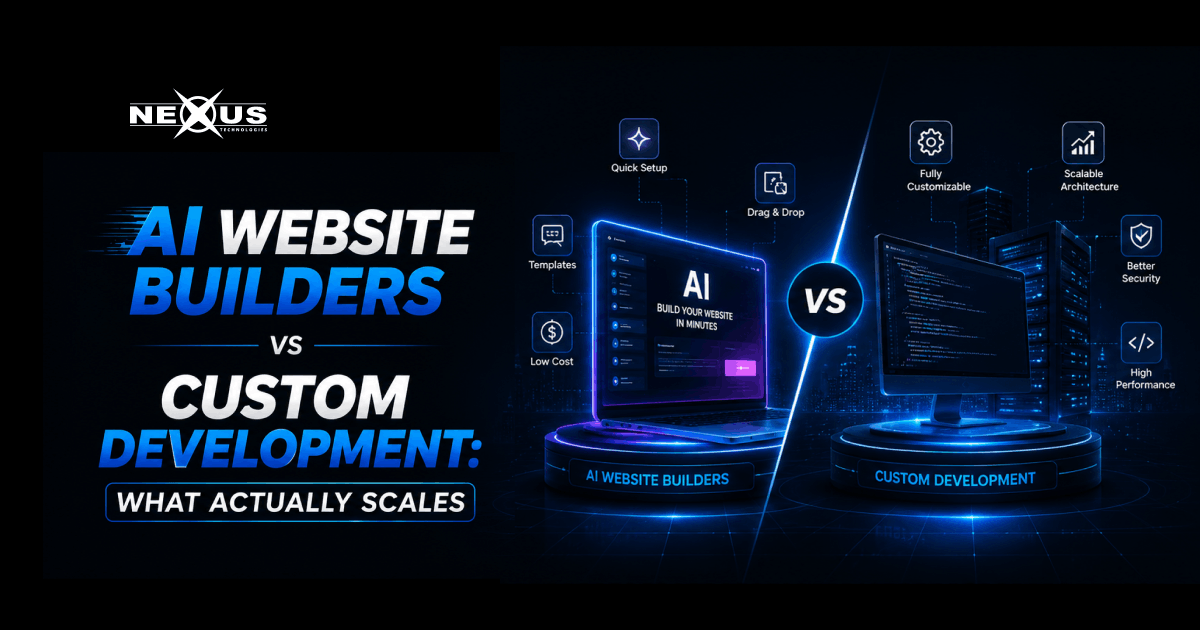
AI website builders can get a basic site online in under an hour, and for a huge number of small businesses that speed is exactly what they need. But the question worth asking before you commit isn’t how fast an AI website builder can launch a site. It’s what happens twelve months later, once your product catalog grows, your traffic spikes, or you need a feature the platform simply doesn’t support. In short: AI website builders win on speed, cost, and removing the blank-page problem, while custom development wins on scale, ownership, and long-term SEO control. This guide breaks down what each approach actually does well, where AI website builders quietly hit a ceiling, and how to decide which path fits your business, using 2026 adoption and performance data rather than vendor marketing.
We build both paths at Nexus, quick AI-assisted sites and fully custom platforms, so this comparison isn’t written to sell one over the other. It’s written to help you avoid picking the wrong one.
- AI website builders are ideal for fast, low-cost website launches.
- Custom development offers better scalability, flexibility, and ownership.
- Growing businesses often outgrow AI builders as complexity increases.
- Custom websites provide greater SEO and integration control.
- Plan for long-term growth before choosing your website platform.
- Choose the solution that fits your business goals, not just your budget.
What AI Website Builders Actually Do Well
The growth of this category isn’t hype.
The global AI website builder market is projected to reach roughly $3.2 billion in 2026, up sharply from the year before, and small businesses are the main driver of that demand, according to recent market research. That growth is earned. AI builders solve three real problems for most business owners:
- Speed. A working, multi-page site that once took a week of back-and-forth with a developer can now come together in minutes, complete with copy, layout, and images generated from a short brief.
- Cost. Instead of a custom project running into the thousands of dollars, an AI builder gets a professional-looking site live for the price of a monthly subscription.
- Built-in SEO basics. Most modern builders auto-generate meta tags, sitemaps, and alt text, and some are now adding answer-engine-optimization features aimed at AI Overviews and chat-based search.
For a single-location service business, a personal portfolio, or a fast-moving campaign microsite, an AI builder is often the right call. We use the same logic for clients who need a portfolio website live fast, without the overhead of a full custom build.
Where They Break Down at Scale
The cracks tend to show up in three places: content volume, custom logic, and raw performance under real traffic.
Page and CMS limits. Popular builders cap how many pages or collection items a site can hold on lower tiers, and even paid plans impose structural limits on how content is modeled. A business that starts with 10 pages and grows to 300 blog posts, product pages, or location pages can outgrow the platform’s data model long before it outgrows its design.
Custom logic and integrations. Booking systems, multi-step quoting tools, ERP connections, and non-standard checkout flows are exactly where builders show their limits. A recent field review of a leading AI site builder found it still falls short on advanced CMS architecture and complex interactions, positioning AI-generated output as a strong first draft rather than a finished, scalable system.
Real-world performance. Independent Core Web Vitals data from 2026 shows a meaningful gap between platforms: some builders post pass rates in the low 70s while others sit closer to 40%, according to website builder performance benchmarks. That gap widens further once a site adds heavier product catalogs, embedded apps, or high traffic volume, which is exactly when performance starts to affect both rankings and conversion rate.
None of this means AI builders are poorly made. It means they are optimized for a different job: getting a site live fast, not carrying an unpredictable, growing business for the next five years.
At a Glance: Cost, Scale, and SEO Trade-offs
Factor | AI Website Builder | Custom Development |
Launch cost | Low, subscription-based | Higher upfront, project-based |
Time to launch | Hours to days | Weeks to months |
Page / content ceiling | Fixed by plan tier | No structural limit |
Custom integrations | Limited to supported apps | Built to spec |
Code and content ownership | Platform-dependent | Fully owned |
SEO / schema control | Templated, some flexibility | Full control |
Migration risk | High, rebuild required | Low, portable codebase |
Best fit | Simple, low-change sites | Growing, complex, or high-traffic sites |
SEO and Ownership Trade-offs
The SEO conversation around AI website builders has shifted. It’s no longer just about meta tags and sitemaps. It’s about who controls the site’s architecture as it grows.
Ownership is the sharper issue. Content, design, and backend logic on most builders live inside a proprietary system. A 2026 analysis of builder lock-in put it plainly: visual builder lock-in creates expensive long-term dependencies, and moving a CMS-driven site off a builder later typically means rebuilding data models and content relationships rather than exporting them cleanly.
Custom development avoids that trap by design. You own the codebase, the hosting environment, and every piece of structured data on the site, which means schema markup, canonical strategy, and internal linking can evolve with the business instead of being boxed in by a platform’s templates. For a deeper look at how this plays out in practice, see how custom web solutions improve website performance and scalability over the life of a growing site.
A Simple Decision Framework for Business Owners
You don’t need a technical background to make this call correctly. Work through these five steps before you commit to either path:
- Map your growth timeline. Write down where the business needs to be in 12 and 36 months, not just at launch, including expected traffic, product count, and integrations.
- List your must-have integrations. Identify every system the site must connect to, such as a CRM, ERP, custom booking engine, or payment gateway, and check whether your shortlisted builder supports each natively.
- Test the SEO and schema ceiling. Check whether the builder allows custom schema markup, canonical control, and full control over URL structure, since these are hard to change later.
- Price the migration, not just the launch. Get a rough estimate of what it would cost to move off the builder in three years if you outgrow it, and weigh that against building custom now.
- Choose the smallest commitment that meets your 36-month plan. Pick an AI website builder if your 36-month plan stays within its limits, or start with custom development if you already know you’ll outgrow a builder.
If step one and two raise more questions than answers, that’s usually a sign the business has outgrown the builder conversation already, and a scoped custom website build is worth pricing out before you commit a year of content to a platform you might need to leave.
Our Take: When to Choose Each Path
Having shipped both quick AI-assisted sites and fully custom platforms for clients across different industries, our team’s honest read is this: AI website builders are the right call when the site’s job is simple and won’t change much, a landing page, a portfolio, a single-location service site. Custom development earns its higher upfront cost the moment a business expects to keep growing content, traffic, or functionality past year one. Most of the failed migrations we’ve been brought in to fix share the same root cause: the business picked the fast option for a job that was never going to stay simple.
FAQs
Can an AI website builder scale into a large business site?
It can handle steady growth for content-driven sites, but most AI builders hit hard limits on page counts, custom logic, and third-party integrations once a business moves past a simple brochure or storefront site.
Is custom development always more expensive than an AI website builder?
Upfront, yes. Custom development costs more to launch. Over several years, the gap often narrows or reverses once you factor in builder subscription tiers, transaction fees, and the cost of rebuilding when the platform runs out of room.
Do AI website builders hurt SEO?
Not inherently. Most modern builders generate clean markup and basic schema. The SEO risk shows up later, when a business needs custom schema, advanced internal linking, or site architecture the builder cannot express.
What is the biggest risk of building on an AI website builder long term?
Platform lock-in. Content, design, and backend logic live inside the builder’s proprietary system, so migrating later usually means rebuilding rather than exporting.
Can I start with an AI website builder and move to custom development later?
Yes, and many businesses do exactly this. It works best when you treat the builder phase as a validation step and plan the migration before traffic or content volume makes the rebuild painful.
Conclusion
Neither AI website builders nor custom development is the universally right answer, and any guide that tells you otherwise is selling something. The honest way to decide is to size the job first: if your site’s scope is genuinely small and likely to stay that way, an AI builder will serve you well and save real money. If you’re expecting growth in traffic, content, or complexity, the cost of custom development is usually smaller than the cost of migrating off a builder later. Whichever path fits, plan for where the business will be in three years, not just where it launches.
Weighing a builder against a custom build for your own project? Get a free custom-vs-builder consultation and we’ll help you size the job before you spend a dollar on either path.